
Client Communication Templates Every Solo Attorney Needs
Twelve ready-to-adapt client communication templates with sample text, from inquiry acknowledgment to closing letter, and the Rule 1.4 duties each one supports.

Good legal work does not feel good to a client who hears nothing about it. The unreturned call, the update that never came, the hearing the client learns about two days before: these are failures of communication, not of skill. The ABA's comment to the diligence rule puts it bluntly: "Perhaps no professional shortcoming is more widely resented than procrastination" (Model Rule 1.3, Comment [3]).
The duty behind this is ABA Model Rule 1.4. It requires a lawyer to keep the client "reasonably informed about the status of the matter," to "promptly comply with reasonable requests for information," to promptly inform the client of decisions that need the client's informed consent, and to "explain a matter to the extent reasonably necessary to permit the client to make informed decisions." Your state's version may differ in wording, so read it.
A solo cannot meet that duty on memory and good intentions across dozens of matters. A template library helps. Below are twelve templates with sample text you can adapt. Square brackets mark the parts you fill in. Each template notes the rule it supports.
How to use these templates
- Store them in your practice management system with merge fields for names, dates and matter details, so a draft is ready when the trigger happens.
- Review every message before it goes. A template handles the structure. You add the facts and the judgment.
- Keep confidential details out of insecure channels. If a message discusses the substance of the matter, send it through your client portal or another channel you have agreed with the client.
- Adapt to your jurisdiction and practice area. These are starting points, not forms approved by any bar.
Before the engagement
1. Inquiry acknowledgment
Send within minutes of a web form, email or voicemail. Do not invite the prospect to send details of their situation until you have run a conflicts check.
Subject: We received your inquiry about [matter type]
Dear [Name],
Thank you for contacting [Firm]. We received your message about [matter type] on [date].
Next step: please complete this short form so we can check for conflicts of interest: [link]. It asks only for names of the people and businesses involved. Please do not send documents or details of your situation yet.
Once the check is complete, we will contact you within [one business day] to schedule a consultation.
Please note that contacting us does not create an attorney-client relationship. If you have a deadline approaching, tell us the date in the form.
[Signature]
2. Conflict check pending
Dear [Name],
Before we can meet, we run a routine check to make sure we have no conflict of interest with anyone involved in your matter. Every law firm does this. We expect to finish by [date] and will contact you then to confirm your consultation.
[Signature]
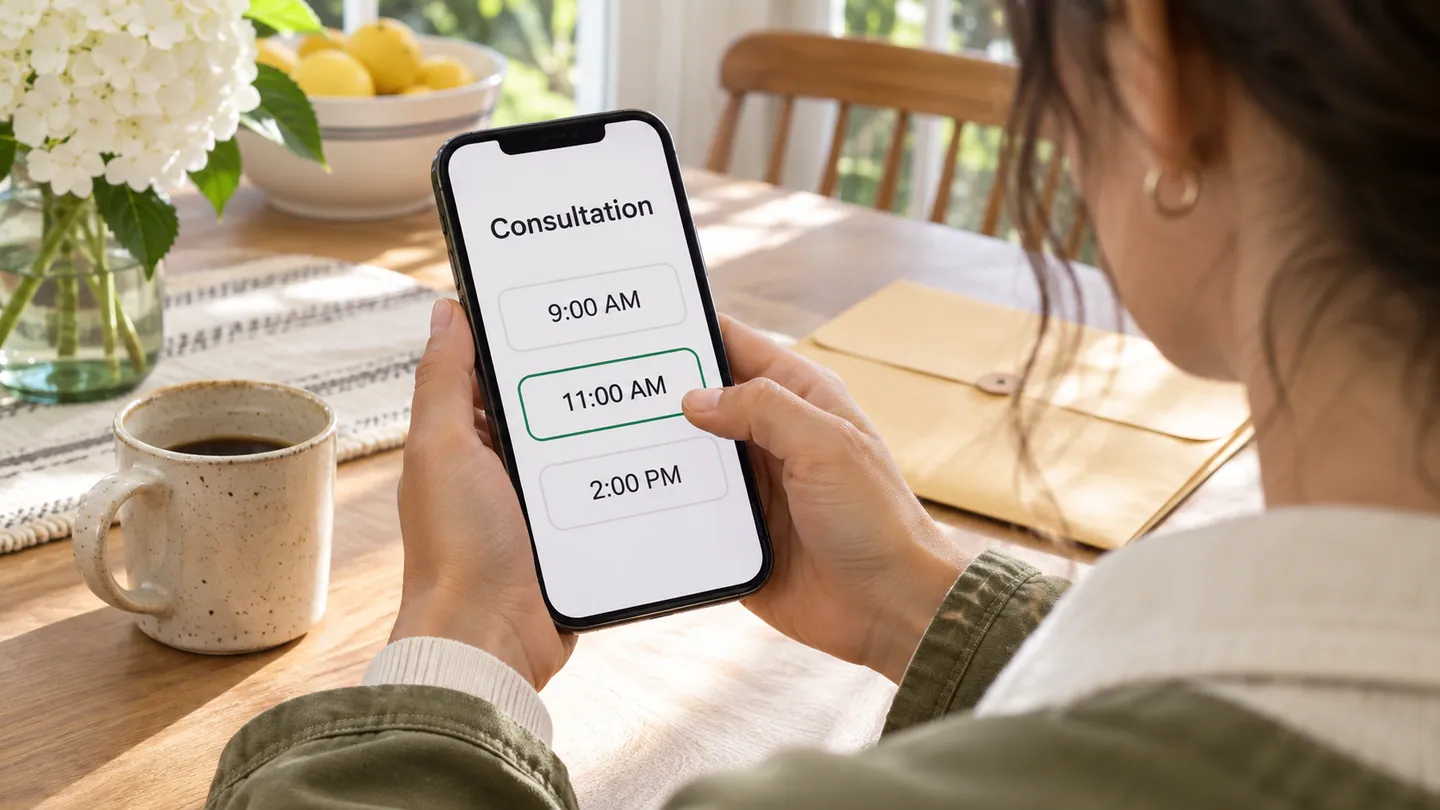
3. Consultation confirmation
Send on booking, with a reminder the day before. Keep the list of what to bring to a few items.
Subject: Your consultation on [date] at [time]
Dear [Name],
Your consultation with [Attorney] is confirmed for [date] at [time], [at address / by video at link].
Please bring or upload: [item 1], [item 2], [item 3].
In the meeting we will review your situation, explain your options and, if you want to go ahead, explain how our fees work. The consultation fee is [amount / no charge].
To reschedule, use this link: [link].
[Signature]
Starting the matter
4. Welcome and engagement confirmation
Send when the engagement agreement is signed. This supports Rule 1.5(b), which requires communicating the scope of the representation and the basis or rate of the fee, "preferably in writing." It summarizes the agreement; it does not replace it.
Subject: Welcome to [Firm]: what happens next
Dear [Name],
Thank you for choosing [Firm]. This letter summarizes our engagement agreement dated [date]. If anything here seems different from the agreement, the agreement controls, and please tell me.
What I will do: [scope in one or two sentences]. What is not included: [exclusions].
Fees: [hourly rate / flat fee and what it covers / payment schedule]. [If an advance payment was made: Your advance payment of $[amount] is held in our client trust account and will be applied as fees are earned.]
How we will communicate: I respond to non-urgent messages within [one business day]. You will receive a status update at least every [interval] and after any significant development. For something urgent, [call / text] [number] and say it is urgent.
Your portal: [access instructions].
What I need from you first: [items and dates].
[Signature]
5. Document request
Subject: Documents needed for [matter] by [date]
Dear [Name],
To [next step, e.g. prepare your financial disclosure], I need the following by [date]:
1. [Document], because [one-line reason].
2. [Document], because [reason].
3. [Document], because [reason].
Please upload them to your portal: [link]. If you cannot find something, tell me and we will work out an alternative. The date matters because [deadline or reason].
[Signature]
During the matter
6. Status update
Send on a schedule set by the matter's stage, and immediately after significant developments. This is the core of Rule 1.4(a)(3).
Subject: Update on [matter], [date]
Dear [Name],
Since my last update: [what happened, in plain language].
Where things stand: [current status].
What happens next: [next steps and expected timing].
What I need from you: [action and date, or "Nothing at the moment."]
Upcoming dates: [deadlines or hearings].
Reply here or through the portal with any questions.
[Signature]
7. Hearing or deadline notice
Send well before the date, with a reminder closer to it.
Subject: [Hearing / deadline] on [date]: please read
Dear [Name],
[Event] is set for [date] at [time] at [place / video link].
Do you need to attend? [Yes / No, and why.]
What I will do beforehand: [preparation].
What you should do: [preparation, documents, dress, arrival time].
What to expect: [how the event will run and how long].
Let me know by [date] if this creates a problem for you.
[Signature]
8. Settlement offer
Under Rule 1.2(a), "A lawyer shall abide by a client's decision whether to settle a matter." Rule 1.4(b) requires explaining the matter well enough for the client to make an informed decision. Only the structure belongs in a template. The assessment must be written fresh each time.
Subject: Settlement offer in [matter]: your decision needed by [date]
Dear [Name],
[Other party] has offered [terms]. The offer is open until [date].
What the offer means for you: [plain-language summary, including net amount after fees and costs if relevant].
My assessment: [strengths and weaknesses of accepting].
If you decline: [next steps, likely timeline, costs and realistic range of outcomes].
Options: accept, reject, or make a counteroffer of [suggested terms, if any].
This decision is yours. I will carry out whatever you decide. Let's talk before [date]: [scheduling link].
[Signature]
Billing
9. Invoice and payment reminders
Invoice: Dear [Name], your invoice for [period / milestone] on [matter] is attached. Total due: $[amount] by [date]. Pay online here: [link]. If you have a question about any entry, please tell me by [date] and I will review it with you.
Day 7 reminder: A quick reminder that invoice [number] for $[amount] is due on [date]. You can pay here: [link]. If you have already paid, thank you, and please ignore this note.
Day 14 reminder: Invoice [number] for $[amount] remains unpaid. You can pay by [methods] at [link]. If something about the invoice is holding up payment, please let me know so we can resolve it.
Day 21 notice: Invoice [number] for $[amount] is now [number] days past due. Under our engagement agreement, payment is due within [terms]. Please pay by [date] or call me to discuss a payment arrangement.
If non-payment may lead you to stop work or withdraw, send a separate, personal letter. Rule 1.16(b)(5) permits withdrawal for a substantial failure to meet an obligation to the lawyer only after "reasonable warning," and court permission may be required in litigation. Charge late fees or interest only if your agreement provides for them and your state allows it.
Ending the matter
10. Closing letter
The closing letter confirms in writing that the representation has ended. Comment [4] to Rule 1.3 says doubt about whether a relationship still exists should be clarified, "preferably in writing," so the client does not assume you are still looking after their affairs. Include obligations that continue after the matter.
Subject: Closing your matter: [matter]
Dear [Name],
[Matter] concluded on [date] with [outcome]. This letter confirms that my representation of you in this matter has ended.
Things you need to do or watch: [deadlines, payments, renewals, rights to exercise, with dates].
Your file: [how to get copies]. We keep files for [period] under our retention policy, after which they are [destroyed securely].
Money in trust: [Any remaining balance of $[amount] has been refunded / There is no balance.]
If you are willing, we would value a review of your experience: [link]. There is no obligation, and we ask every client the same way.
Thank you for trusting me with this matter. If new legal questions come up, please get in touch.
[Signature]
Make the review request the same for every client, with no condition or incentive. Google's Maps content policy bars offering incentives "in exchange for posting any review," and the FTC's consumer review rule bars incentives conditioned on a particular sentiment. Check your state's rules on testimonials. If a review is negative, ABA Formal Opinion 496 says any response must not disclose information relating to the client's representation. Our guide to getting more reviews ethically covers the details.
11. Referral thank-you
Two rules shape this message. Rule 1.6(a) bars revealing "information relating to the representation of a client" without informed consent or another exception. That phrase is broad enough to cover the fact that a person consulted or hired you, so do not name the client or the matter to the referrer without the client's consent. And Rule 7.2(b) bars giving anything of value for a recommendation, apart from narrow exceptions such as "nominal gifts" not intended or reasonably expected as compensation.
Dear [Referral source],
Thank you for recommending me. I can't share details about anyone who contacts my office, but I want you to know I appreciate your confidence.
As a reminder, my practice is focused on [areas], and I am [taking new matters / currently booking consultations from (date)].
[Signature]
If the client consents in writing to your telling the referrer that you are working together, you can say so. Keep anything beyond that to the client's wishes.
12. Former-client check-in
Send six to twelve months after closing. Keep it short and useful. If the message promotes your services, your state's advertising rules may apply.
Dear [Name],
It has been [time] since we finished [matter type]. I wanted to check that everything is in order, especially [ongoing obligation, e.g. the trust funding we discussed].
[Optional: One recent development that may be relevant: (one or two sentences).]
If any questions have come up, I'm happy to talk: [scheduling link].
[Signature]
Setting up the system
Twelve templates in a folder are not a system. Load each into your practice management software, map the merge fields, and attach each to its trigger: a form submission, a signed agreement, a stage change, a calendar entry, an invoice date or a closing date. Test each one on a dummy matter before it goes live.
The one-time setup takes a few hours. After that, every client gets the same baseline of communication regardless of how busy your week is, and your time goes into the parts that need a lawyer: the facts, the assessment and the advice. For the onboarding side of this process, see our new client onboarding checklist.
This article is general information for lawyers, not legal advice. Rules of professional conduct differ by jurisdiction; check your state's rules and bar ethics opinions before relying on anything here. See our disclaimer and editorial standards.
Lexfora is practice-management software for solo and small law firms, currently in early access. Request early access.
About this article
This is practice-management guidance, not legal advice, and reading it creates no attorney-client relationship. Rules on advertising, fee arrangements and trust accounting vary by state — check your own jurisdiction's rules and your bar's guidance before acting on anything here.
Put these systems on rails
Turn your intake, matter workflows, client updates and billing into repeatable systems with Lexfora.
Request Early AccessRelated Articles

How to Run a Solo Law Practice Without Burning Out
Why solo practice wears lawyers down, and the boundaries, systems and attention habits that make it sustainable, with the ethics limits on automating intake and billing.
The Solo Attorney's Complete Guide to Automating Client Intake
How to automate client intake from first inquiry to signed engagement letter, while meeting your Rule 1.18 duties to prospective clients.

How to Manage 50+ Active Cases as a Solo Practitioner
Systems that let a solo attorney handle a high caseload without missed deadlines or neglected clients, and the Rule 1.3 duty to keep the workload at a level each matter can be handled competently.