
AI-Powered Legal Research: How to Cut Research Time Without Cutting Corners
What AI research tools do well, who owns the major platforms now, a workflow that keeps verification in the loop, and what ABA Formal Opinion 512 requires.

AI research tools can find a starting set of cases in minutes. They can also hand you a confident summary of a case that does not exist. Both facts shape how a solo attorney should use them.
This guide covers what the tools do well, which major platforms exist and who owns them now, a research workflow that keeps verification in the loop, and the ethics rules that apply. It does not promise a number of hours saved. We know of no independent study that measures research time saved for solo practices, and your savings will depend on your practice area, your prompts and how much checking the output needs.
What AI Research Tools Do Well
Orientation on an unfamiliar question. Ask a legal research assistant a plain-English question, such as what factors a Delaware court weighs before piercing the corporate veil. A good tool returns a short answer with links to the cases it relied on. That gives you a map before you start reading.
Triage. Summaries help you decide which of thirty search results deserve a full read and which can wait.
Adverse authority sweeps. You can ask directly for cases that cut against your position. That prompt is worth running on every matter, because it is the search that busy lawyers skip.
Multi-jurisdiction surveys. A first-pass comparison of how several states treat the same issue is faster to produce with a tool than by hand. Treat it as a draft of a survey, not the survey.
What They Do Not Do
They do not exercise judgment. Deciding which case is closest on the facts, how a particular judge is likely to rule and which argument is worth making is still your work.
They do not guarantee accuracy. Tools built on a legal database and designed to cite their sources make fewer fabrication errors than a general chatbot. Fewer is not zero. A tool can also cite a real case for a point the case does not support. Every citation needs to be read and checked before you rely on it.
The Major Platforms and Who Owns Them
This market has consolidated quickly. Anything you read about these products from a year or two ago may describe a company or a product name that no longer exists. Here is the ownership picture as of November 2026, with the source for each fact.
CoCounsel (Thomson Reuters). CoCounsel began as a product of Casetext. Thomson Reuters completed its acquisition of Casetext in August 2023. CoCounsel now sits inside Thomson Reuters' legal products. In August 2025 the company announced CoCounsel Legal, including a "Deep Research" feature on a Westlaw tier it calls Westlaw Advantage. If you already subscribe to Westlaw, ask your representative which AI features your current plan includes and what the AI tier costs. Do not assume the AI is included.
Lexis+ with Protégé (LexisNexis). LexisNexis first sold its AI research features as Lexis+ AI and later added an assistant called Protégé. In February 2026 it announced general availability of Lexis+ with Protégé in the US, describing it as the replacement for Lexis+ AI as its flagship product.
vLex, Fastcase and Vincent AI (now Clio). Fastcase and vLex announced their merger in April 2023. The combined company's AI research assistant is Vincent AI. Clio, the practice management company, completed its acquisition of vLex in November 2025. Some bar associations have offered Fastcase access as a member benefit. If yours does, ask whether the benefit includes the AI features or only the case law database.
Free sources plus a general chatbot. Google Scholar and court websites give you free access to many opinions. Pairing them with a general-purpose chatbot for summaries is cheap. It is also the setup most likely to produce invented citations, because a general chatbot is not drawing from a legal database. Use it for orientation on familiar questions, never as the research itself. Before you paste anything about a client into one, read the confidentiality section below.
None of these vendors publishes a simple price list for solo attorneys that we could confirm. Get a written quote, and ask for the price of the AI features separately from the base research subscription.
A Research Workflow That Keeps Quality
Use the tool where it speeds up mechanical work. Keep your own judgment at the points where it cannot be delegated.
- Frame the question. Write down the issue, the jurisdiction and the facts that matter. A vague prompt returns a vague survey. Ask for the governing standard, the leading cases and the main lines of disagreement.
- Read the survey critically. Note anything surprising or missing. Use the survey to build a reading list, not a conclusion.
- Do the deep reading yourself. Use summaries to sort the reading list. Read in full every case you expect to cite.
- Run the adverse and gap prompts. Ask for cases that reject your position in your circuit or state. Ask what related issues a court might raise that your analysis does not address.
- Verify everything. This step belongs to you alone. It is covered next.
Verification Is Not Optional
The best-known warning is Mata v. Avianca, Inc., 678 F. Supp. 3d 443 (S.D.N.Y. 2023). Lawyers filed a brief citing cases that a chatbot had invented. Judge Castel sanctioned the lawyers and their firm $5,000. The court said there is nothing inherently improper about using AI, but that lawyers remain responsible for the accuracy of what they file. The sanction turned as much on how the lawyers responded after the fake cases were flagged as on the original error.
A verification routine that holds up:
- Pull the full text of every cited authority from an authoritative source.
- Confirm the case exists and says what the summary claims, including the pin cite.
- Run every case through a citator to confirm it is still good law.
- Check statutes and rules against the current official version.
- Note in the research file what you checked and when.
Budget real time for this. It is part of the research, not an afterthought, and it is the step any time savings must be measured against.
The Ethics Rules That Apply: ABA Formal Opinion 512
In July 2024 the ABA issued Formal Opinion 512 on generative AI tools. It creates no new rules. It explains how the existing Model Rules apply. A summary in The Bar Examiner is a readable companion. The main points for research:
- Competence (Rule 1.1). You need a reasonable understanding of what the tool can and cannot do, and you must check its output at a level that fits the task. Comment 8 to Rule 1.1 already says a lawyer should keep abreast of "the benefits and risks associated with relevant technology."
- Confidentiality (Rule 1.6). Before you put information relating to a client's representation into a self-learning tool, one that may use your inputs to train or answer other users, the opinion says you need the client's informed consent. It says boilerplate consent in an engagement letter is not enough. Even with tools that do not train on your inputs, you must understand the vendor's data terms.
- Communication (Rule 1.4). Tell the client about your AI use if the client asks, and consider whether the circumstances require you to raise it yourself.
- Candor and meritorious claims (Rules 3.1, 3.3, 8.4(c)). Unverified citations in a filing put you on the wrong side of these rules.
- Supervision (Rules 5.1, 5.3). If anyone else in your office uses these tools, set written rules for how, and check their work.
- Fees (Rule 1.5). If you bill hourly, bill only the time you actually spent. You may not bill for time saved as if you had spent it. Generally you may not charge a client for time spent learning a tool you will use across your practice. Whether a tool's subscription cost can be passed on or is overhead depends on the circumstances.
Many states have issued their own AI opinions, and they do not all say the same thing. Two examples: the Florida Bar's Ethics Opinion 24-1 (January 2024) and the Texas Professional Ethics Committee's Opinion 705 (February 2025). Check what your own state has issued before you build a workflow.
What the Savings Are Worth, Honestly
The fee rules change the usual pitch. Here is an illustrative example with made-up numbers. Suppose a memo that once took eight hours now takes five, verification included.
- If you bill hourly, the client pays for five hours, not eight. The saving goes to the client. Your gain is three free hours you can use for other matters or for rest.
- If you charge a flat fee, you keep more margin on that matter. The fee still has to be reasonable under Rule 1.5(a), and Opinion 512 warns that a fee for work that took little or no effort can be unreasonable.
Either way, the case for AI research is capacity and coverage, not billing more for the same work.
Where It Helps Most and Where to Slow Down
Tools tend to do best on questions with a large, stable body of case law and settled doctrine, such as many contract and commercial questions. Slow down on fast-moving areas, on questions that turn on recent decisions, and on technical areas like tax where a small error in a cited provision changes the answer. In those areas, use the tool for orientation and do the deep research yourself.
For a wider look at which AI categories are worth paying for, see our guide to AI tools for solo attorneys. For drafting rather than research, see our guide to drafting legal documents with AI.
This article is general information for lawyers, not legal advice. Rules of professional conduct differ by jurisdiction; check your state's rules and bar ethics opinions before relying on anything here. See our disclaimer and editorial standards.
Lexfora is practice-management software for solo and small law firms, currently in early access. Request early access.
About this article
This is practice-management guidance, not legal advice, and reading it creates no attorney-client relationship. Rules on advertising, fee arrangements and trust accounting vary by state — check your own jurisdiction's rules and your bar's guidance before acting on anything here.
Put these systems on rails
Turn your intake, matter workflows, client updates and billing into repeatable systems with Lexfora.
Request Early AccessRelated Articles
AI Tools for Solo Attorneys: What's Actually Worth Using
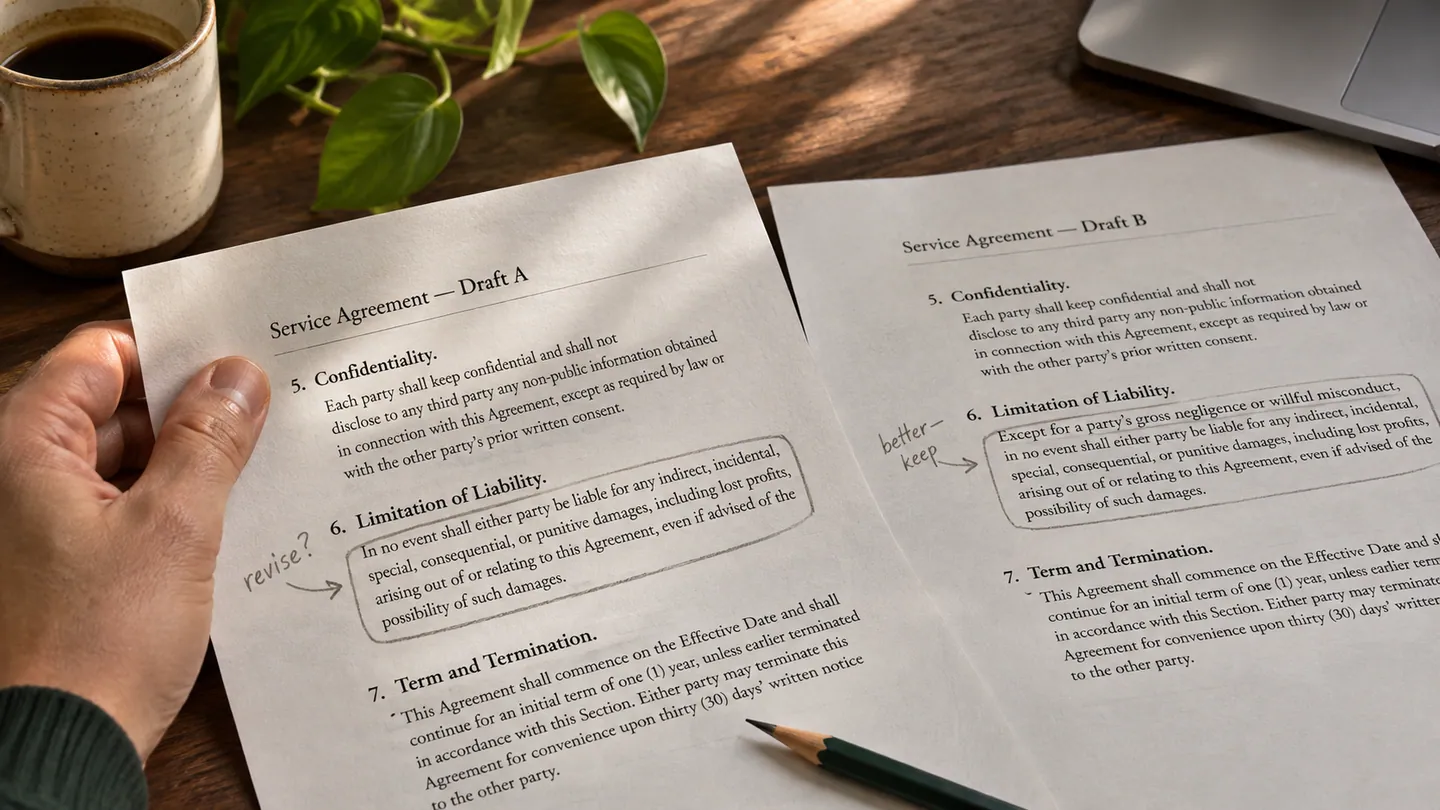
Which AI tools a solo attorney can actually buy and use safely, by task: research, drafting, contract review, practice management and intake, with the ABA Opinion 512 baseline.

Using AI to Draft Legal Documents: A Solo Attorney's Guide
Which documents benefit from AI drafting, how to prompt and review, and what ABA Formal Opinion 512 requires on confidentiality, disclosure, supervision and fees.